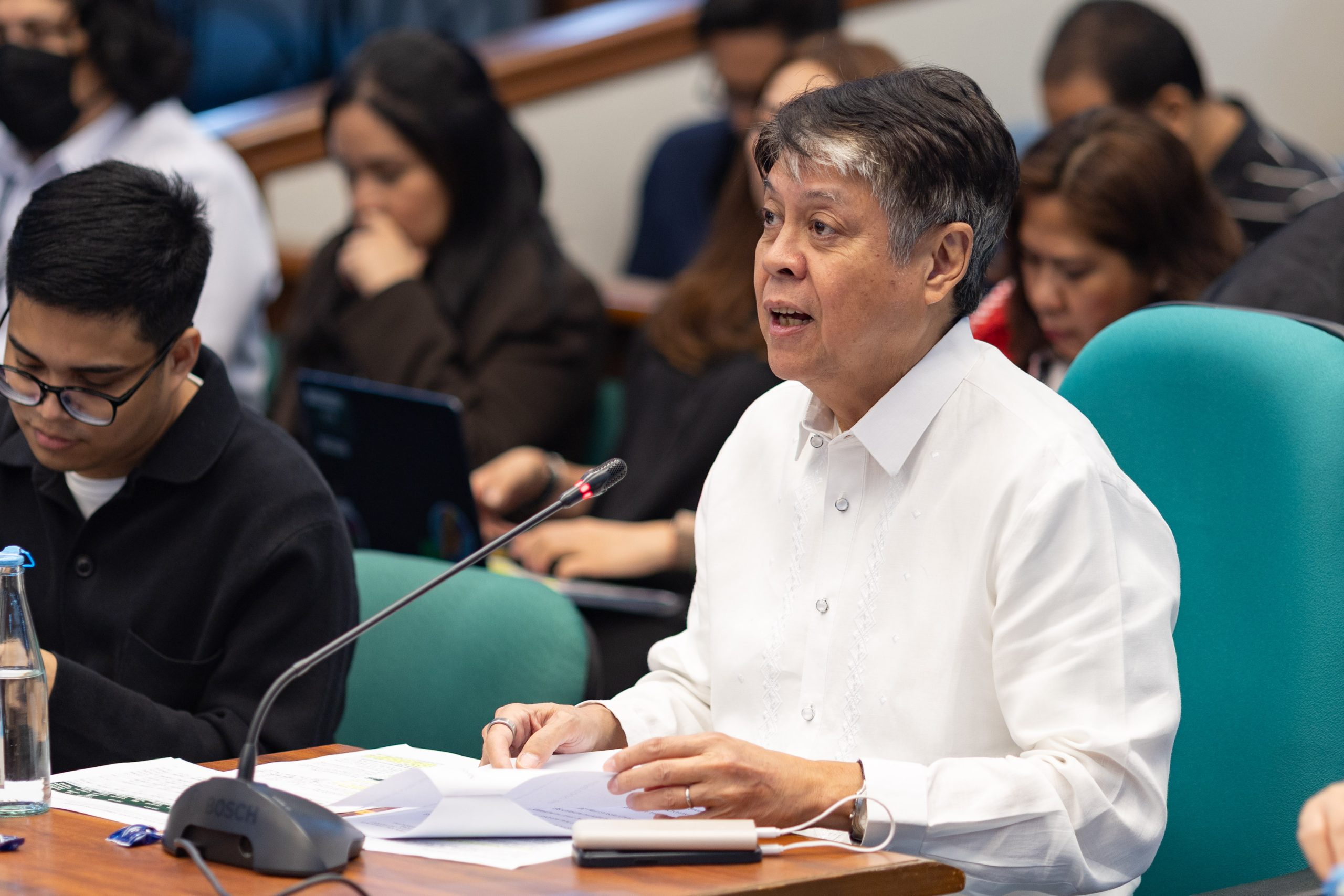
Sen. Francis “Kiko” Pangilinan is pushing for stricter validation of farm-to-market road (FMR) projects and greater transparency in bicameral budget deliberations to ensure that public funds go to legitimate, necessary, and implementation-ready projects that benefit farmers and agricultural communities.
During the Senate plenary deliberations on the proposed 2027 budget of the Department of Agriculture (DA) on Friday, November 27, Pangilinan, sponsor of the DA’s proposed 2027 budget, said the agency and civil society organizations (CSOs) were reviewing FMR projects inserted in the House version of the proposed national budget.
The House added 353 FMR projects worth ₱5.92 billion that were not part of the DA’s original proposal under the National Expenditure Program (NEP), while dropping 91 projects worth ₱2.23 billion that were included in the NEP.
Pangilinan said the House insertions were still undergoing review and that projects that had not yet been validated were excluded from the Senate committee report.
He clarified that the Senate’s 146 additional FMR projects worth ₱3 billion were initiated by the DA in response to El Niño and had undergone validation.
In his interjection, Senate President Sherwin “Win” Gatchalian credited Pangilinan and the Senate Committee on Finance for introducing the strict FMR Network Plan requirement last year. Under this requirement, projects not included in the DA’s master plan were excluded from the Senate budget version, regardless of whether they were proposed by senators or members of the House of Representatives.
“Ito po ay ginawa ho ni Senator Kiko at ng Committee on Finance last year,” Gatchalian said, recalling how strictly the Senate enforced the requirement.
He said the Senate would apply the same rule this year and strengthen project verification by using available online portals to cross-check the technical descriptions of proposed road projects.
Pangilinan affirmed that the requirement would remain in place, with verification reports serving as additional documentation and safeguards. These reports, according to him, would also be published through the People’s Budget Coalition’s FMR monitoring portals.
In his opening statement, Pangilinan cited the nearly two weeks of review conducted by the DA, the Legislative Budget Research and Monitoring Office (LBRMO), the People’s Budget Coalition, his office, Senate President Win Gatchalian, and Senate Finance Committee Chairperson JV Ejercito, covering more than 1,000 budget line items.
The review led to corrections of identified discrepancies and errors in proposed allocations, including those involving FMR projects.
“Ganito dapat ang proseso ng pagbabadyet: bukas, malinaw, at kasama ang mamamayan sa pagbubusisi,” Pangilinan said.
He thanked the People’s Budget Coalition and other CSOs for their vigilance and active participation in scrutinizing public spending.
Pangilinan also supported stronger transparency measures in the bicameral conference committee proceedings, including inviting the Commission on Audit (COA), the Office of the Ombudsman, and CSOs as observers. A representative from the Supreme Court may also be invited, subject to the Court’s decision.
He said the participation of independent observers would help ensure that the bicameral process is open to public scrutiny.
“The bicameral conference committee must be transparent and must be accountable and participatory,” he said.
Pangilinan also agreed with Sen. Panfilo “Ping” Lacson’s call to continue livestreaming bicameral proceedings, including during suspended sessions, so the public and CSOs can monitor discussions and proposed changes to the budget.