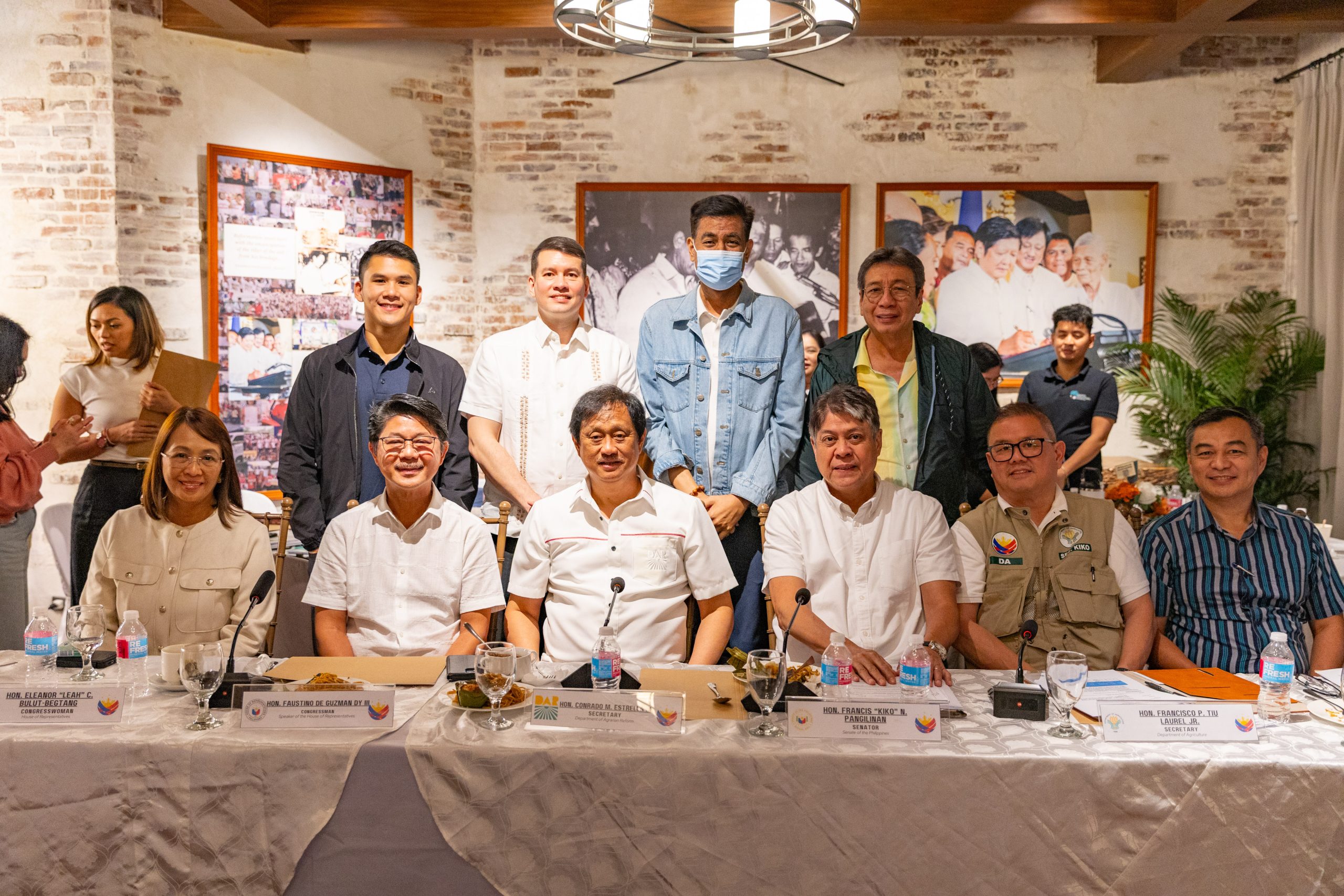
Senator Francis “Kiko” Pangilinan said that all national government offices, agencies, and their local government units must stop buying imported rice—and instead purchase directly from local producers—for their food programs to help improve the livelihoods of rice farmers.
The agreement was reached with the consensus of Speaker Faustino “Bojie” Dy III, Department of Agriculture (DA) Secretary Francis “Kiko” Laurel, Department of Agrarian Reform (DAR) Secretary Conrado Estrella III, ULAP National President Gov. Dakila “Dax” Cua, Isabela Gov. Rodolfo “Rodito” Albano III, House Committee on Agriculture and Food chair Rep. Mark Enverga, House Committee on Agrarian Reform chair Rep. Leah Bulut-Begtang, and National President of the League of Municipalities of the Philippines Mayor Inno Dy.
The senator and chair of the Senate Committee on Agriculture, Food, and Agrarian Reform welcomed the support of key government officials and local chief executives during a meeting with DAR, DA, lawmakers, and the Union of Local Authorities of the Philippines (ULAP) on Thursday, Oct. 9.
“As far as government purchases of rice are concerned, it has to be locally produced rice. Government corporations, agencies, and local governments should not buy imported rice. They should buy local,” Pangilinan said.
“Ito na yung kailangan natin gawin kasi talagang matindi na po ang tama sa ating mga farmers. Saka kung maaari lamang, Secretary, talagang bawal dapat bumili ang mga government, ang ating mga department ng mga imported rice, dapat locally produced rice,” Speaker Dy added.
This comes amid the senator’s appeal to Malacañang to issue executive orders on setting a minimum floor price for wet and dry palay for government purchases.
Setting a floor price for palay for government purchases will stabilize the incomes of farmers, who have been forced to sell palay for an average of P7.66 per kilo—way below the production cost of P13.51 per kilo—because of abusive traders and middlemen.
Noting that the government is the country’s biggest employer, Pangilinan pointed out how government agencies and instrumentalities can provide the biggest market access to local food producers such as farmers and fisherfolk.
This falls in line with his 2019 Sagip Saka Act, the landmark law that he authored and passed to allow all national government offices, agencies, and local government units to directly purchase produce from farmers and fisherfolk without public bidding.
It aims to improve the livelihood of farmers and fisherfolk by providing them direct access to government purchases of food that amount to an estimated P150 billion annually.
Pangilinan said state colleges and universities, military camps, jails, and social amelioration programs must source their food directly from local agricultural workers under the Sagip Saka law.
Earlier, the senator underscored the need for the executive and legislative branches of government to work together to achieve food security and rural development, as well as uplift the welfare of farmers and fisherfolk. This follows his campaign message of “walang kulay ang gutom” as he aims to address the pressing issues of hunger and food insecurity.
Pangilinan explained that the government must take the lead in empowering farmers and saving them from abusive trade practices by fully implementing the Sagip Saka law.