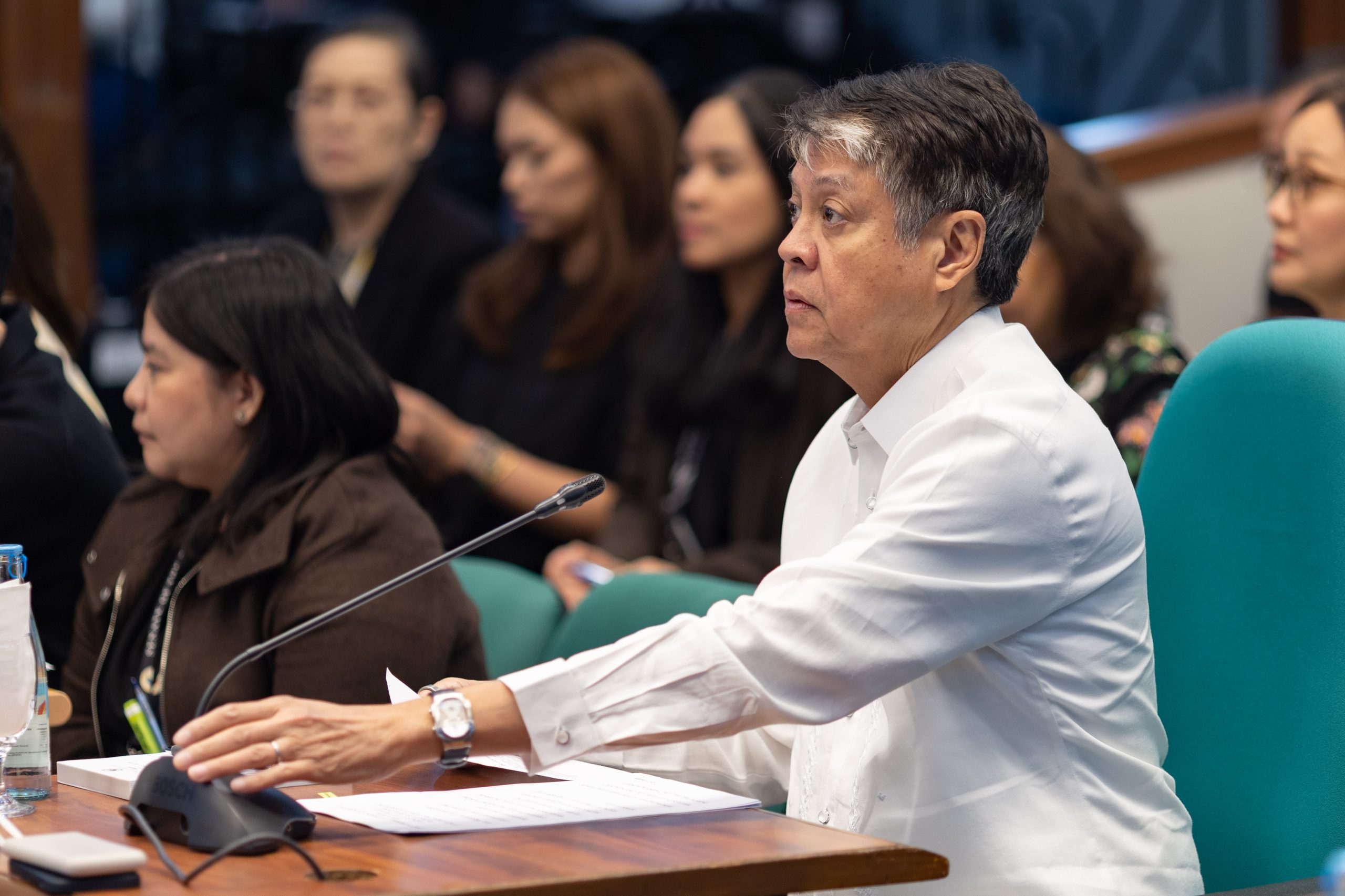
Sen. Francis “Kiko” Pangilinan is pushing for reforms to make the justice system faster, more accessible, and more accountable to ordinary Filipinos as he sponsored the proposed ₱84.13-billion budget of the Judiciary for 2027.
During the Senate plenary deliberations on Friday, November 27, Pangilinan called for full funding of the Judiciary’s proposed budget, emphasizing the need to address case backlogs, expand free legal assistance, strengthen judicial integrity, and improve court facilities and security.
“Malugod nating inihaharap ang kauna-unahang budget ng bagong Punong Mahistrado na si [Chief Justice] Rodil Zalameda. Ito rin ang unang budget ng Hudikatura sa ilalim ng Judiciary Fiscal Autonomy Act o Republic Act No. 12233,” Pangilinan said in his opening statement.
Signed into law on August 14, 2025, Republic Act No. 12233 strengthens the Judiciary’s financial independence by requiring the Supreme Court’s original budget proposal to be included in the National Expenditure Program (NEP) submitted to Congress. It also mandates the automatic monthly release of the Judiciary’s approved funds and gives the Chief Justice greater flexibility to reallocate funds within the limits set by law. All Judiciary revenues and expenditures remain subject to audit by the Commission on Audit (COA).
Pangilinan said access to justice remains difficult for ordinary Filipinos, with many believing that cases move quickly for the wealthy and powerful but drag on for those who cannot afford legal proceedings.
“Mailap para sa ordinaryong mamamayan ang hustisya. Maraming Pilipino ang naniniwalang mabilis umusad ang sistema para lang sa mayayaman at makapangyarihan, at mabagal para sa karaniwang mamamayan,” he said.
“Justice delayed is justice denied,” Pangilinan stressed, citing Judiciary data showing that as of August 31, 2026, a total of 98,633 cases had been pending for at least five years in first- and second-level courts. Of these, 49,475 had been pending for at least 10 years.
To address case delays, Pangilinan cited the Judiciary’s Revised Guidelines for Continuous Trial of Criminal Cases, which require trials covered by the regular rules to be completed within 180 days from the first day of trial. Judges are then given 90 days to decide cases after these are submitted for decision.
He also highlighted simplified procedures under the Summary Procedure and Small Claims rules to reduce litigation costs and speed up the resolution of disputes.
Another priority is the use of technology to make court processes more efficient and accessible. Under the Judiciary’s Strategic Plan for Judicial Innovations, the E-Court PH initiative seeks to digitize document filing, case monitoring, and the safekeeping of court records.
Pangilinan also underscored the importance of expanding free legal assistance for indigent Filipinos through the Unified Legal Aid Service (ULAS).
“Palawakin ang access sa hustisya ng mga mahihirap,” he said, highlighting the need to make legal assistance more accessible to those who cannot afford a lawyer.
For 2027, the Judiciary is prioritizing the full implementation of the ULAS portal and the establishment of a Legal Aid Referral System to make it easier for those in need to find legal assistance.
On judicial accountability, Pangilinan expressed support for strengthening the Judicial Integrity Office (JIO), which recorded 594 administrative complaints from October 2025 to August 2026 and submitted 378 investigation reports to the Supreme Court from January to August 2026.
He emphasized the need to strengthen integrity and accountability within the Judiciary to uphold public trust in the justice system.
He also called for stronger security for judges and court personnel through the Office of the Judiciary Marshals, which is tasked with protecting approximately 30,000 justices, judges, and court personnel nationwide.
The senator likewise emphasized the need to improve court facilities, noting that 224 additional Halls of Justice still need to be constructed to provide courts with adequate and suitable facilities.
Pangilinan also cited the Justice Sector Convergence Program, which brings together the Supreme Court, Department of Justice (DOJ), and Department of the Interior and Local Government (DILG) to improve coordination in the delivery of justice. An estimated ₱187.995 million is needed in 2027 to operate and expand Justice Zones nationwide.
Beyond these reforms, Pangilinan renewed his call for the convening of the Judiciary-Executive-Legislative Advisory and Consultative Council (JELACC) to strengthen coordination among the three branches of government.
He said the council could serve as a platform for coordinating adequate funding and pursuing institutional reforms while respecting the independence of the Judiciary.
“Pondohan natin nang buo ang budget na ito. Igalang natin ang fiscal autonomy ng Hudikatura,” Pangilinan urged his colleagues.
“Bigyan natin ang sambayanan ng isang sistemang pangkatarungang ika nga ‘dasurb’ ng tiwala nating lahat,” he added.