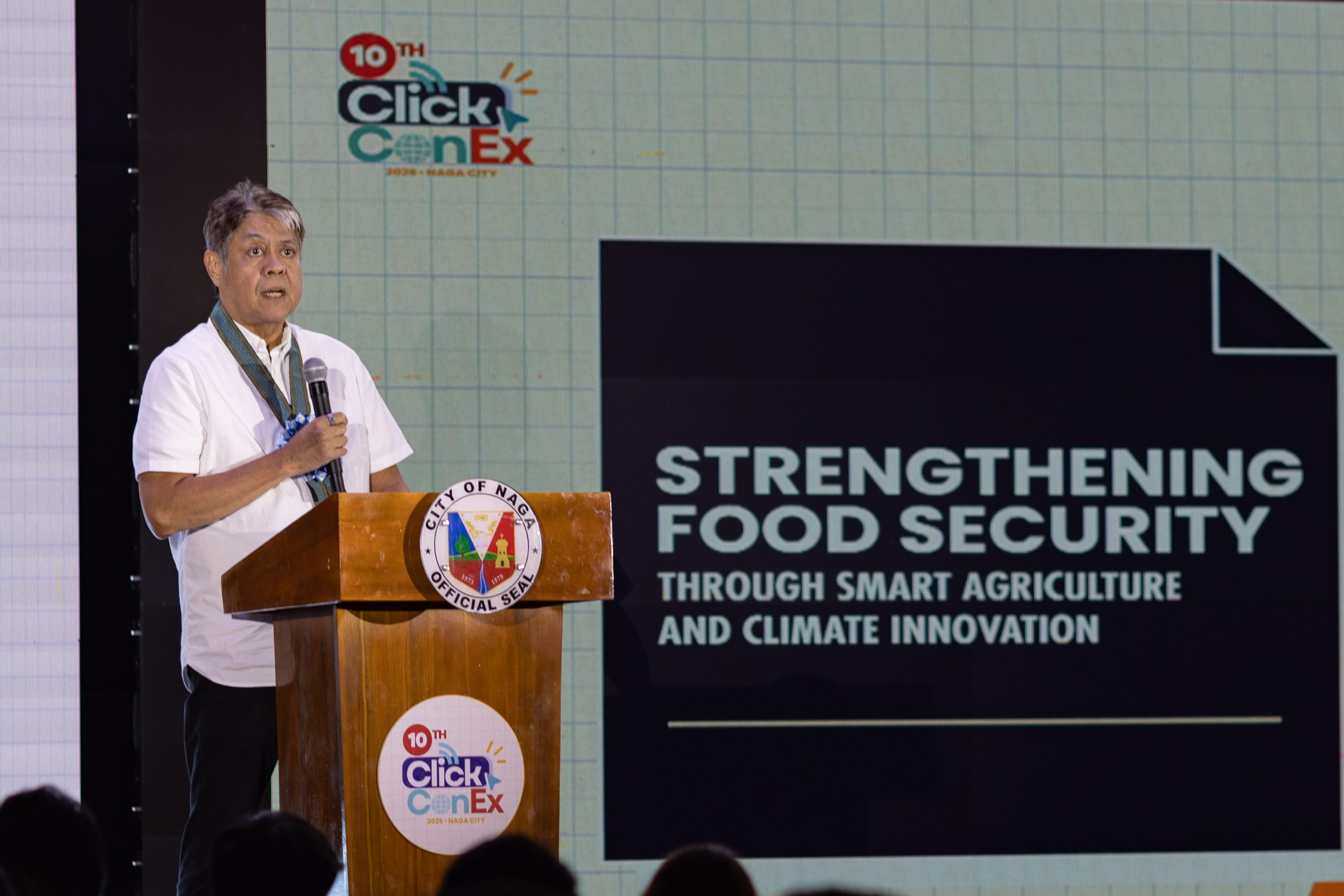
Senator Francis “Kiko” Pangilinan called on local governments, technology innovators, academic institutions, and the private sector to unite in adopting smart agriculture and climate-resilient solutions to ensure national food security.
In his keynote message at the “10th ClickConEx: Convergence of Luzon I.C.T. Champions and Exhibitions” on Friday, June 19, 2026, in Naga City, the senator recognized how technology could be a game-changer for farmers and fishers.
“Ang kaalaman ay kapangyarihan,” he said, noting that farmers and fisherfolk could easily access information about weather forecasts, pest warnings, market prices, and planting advice through their smartphones.
He also added that information and communications technology (ICT) can directly connect producers to consumers through a seamless, digitally enabled supply chain.
The four-term lawmaker allayed fears that the use of technology in the agriculture and fisheries sectors would replace traditional farming.
Rather, he said it would build on generations of indigenous and farming knowledge—from farmers who have passed down wisdom about nature and planting to fisherfolk who best understand the rhythm of the sea—and strengthened by science, data, and technology.
“If we want to have ample food supply, we must mobilize resources towards the weakest link and provide them with capacity, with technology, with organization, with extension service,” Pangilinan said.
After weeks of a Senate impasse, two of the senator’s twin measures to reform and modernize the agriculture and fisheries sectors passed on second reading.
Renationalizing extension services will give farmers and fisherfolk access to technical assistance, training, modern farming practices, veterinary services, pest management, and new technologies down to the municipal level.
At the same time, reestablishing the Bureau of Agriculture Cooperatives would strengthen farmers’ and fisherfolk’s capacity to organize themselves and compete effectively. As a cooperative, they can buy inputs at lower prices, access credit more easily, invest in equipment and machinery, process their products, and negotiate better prices in the market.
“Anong saysay ng teknolohiya kung hindi organisado ang food producers natin, ang mga magsasaka at mangingisda? Ano man ang intervention na gagawin ng national at local governments, kung hindi naman organisado at capacitated ang farmers at fisherfolk ay hindi magiging sustainable ang anumang intervention,” Pangilinan explained.
“The lessons of superpowers in agriculture in the region is that they have a strong organized farming and fishing cooperatives regulations and associations,” the senator, who has previously cited Taiwan, Vietnam, and Thailand for their strong agriculture and fisheries sectors, added.
Pangilinan, who resumes his role as chair of the Senate Committee on Agriculture, Food, and Agrarian Reform, vowed to continue his advocacy of not only reforming and modernizing the agriculture and fisheries sectors, but also protecting the rights and livelihoods of farmers and fisherfolk.
The senator attended the event together with Senator Bam Aquino and Naga City Mayor Leni Robredo.