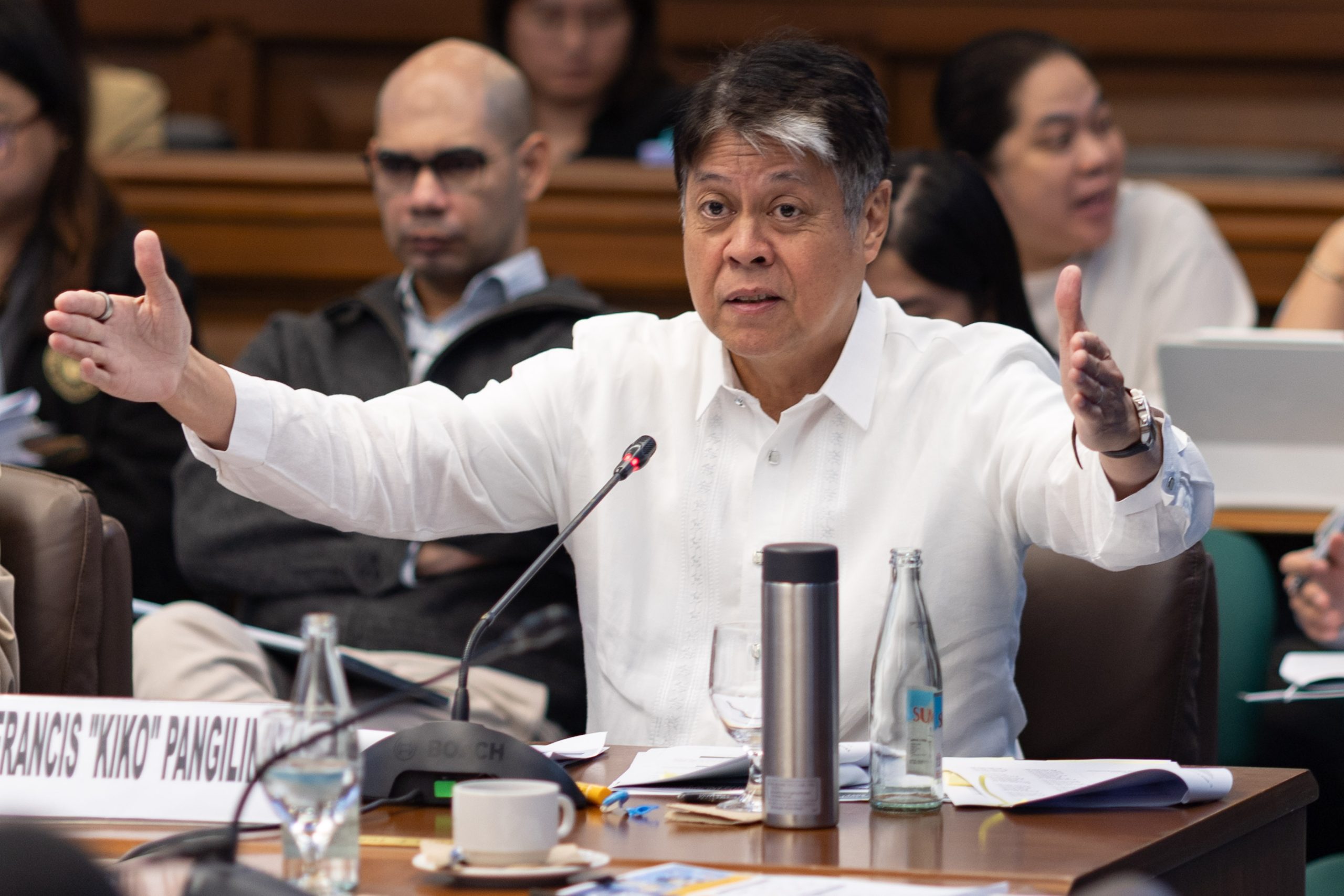
Senator Francis “Kiko” Pangilinan has begun scrutinizing how government agencies are implementing the Sagip Saka Act during the Department of Education’s proposed budget hearing on Thursday, October 16, emphasizing the need to maximize the law’s potential to provide farmers and fisherfolk with stable markets for their produce.
The senator and chair of the Senate Committee on Agriculture, Food, and Agrarian Reform is the principal author of Republic Act No. 11321, or the Sagip Saka Act, which allows the national government agencies and the local government units to purchase food directly from accredited farmers’ and fisherfolk cooperatives without public bidding.
During the DepEd’s proposed budget hearing for the 2027 fiscal year, the senator raised the issue as part of his continuing efforts to ensure that government agencies fulfill their obligations under the law and use public funds to support local agricultural producers.
“And I’d like to think in fairness the full implementation of the Sagip Saka program for your feeding program dahil naumpisahan na pasukan ng August – So, you’re really still in the initial stages of being able to implement the program, and so we’ll grant you that,” he told DepEd officials, led by DepEd Secretary Sonny Angara.
“But we’d like to, during plenary, just submit to us—How do you intend to fully implement this? What are the challenges? What do we have to address on the supply side? The demand side walang problema eh. Yung supply side, I’m sure you’re going to have a lot of challenges there, and we’d like to address both,” he added.
While Sagip Saka addresses the demand side of the agricultural sector, Pangilinan is also pushing for the passage of two key proposals pending in Congress: the strengthening of agricultural cooperatives and the renationalization of agricultural extension services.
The proposed Agricultural and Fisheries Extension Services Act seeks to establish a stronger, more responsive, and better-coordinated national extension system that will provide farmers and fisherfolk with timely technical assistance, research-based technologies, climate-smart farming practices, and continuous capacity-building.
The Agricultural Cooperatives Act, on the other hand, will reestablish the Bureau of Agriculture Cooperatives. It aims to strengthen farmers’ and fisherfolk’s capacity to organize themselves and compete effectively.
Once capacitated, agricultural cooperatives will have improved access to financing, markets, equipment, and value-adding opportunities.
During Friday’s hearing, DepEd proposed cutting the school-based feeding program’s 2027 budget to P11 billion from the P25 billion allocated in the previous budget cycle, citing unspent funds from 2026 that will be carried over to the following year. The agency had spent only P3.5 billion of its previous P25-billion allocation.
Pangilinan expressed concern that the proposed budget reduction could affect the implementation of DepEd’s school-based feeding program, while underscoring the need for the agency to fully implement the Sagip Saka Act by prioritizing the procurement of food products directly from accredited farmers’ and fisherfolk enterprises.
“Maybe you can prepare for plenary because I’ll raise this again: What is the impact of the reduction from ₱25 billion to ₱11 billion?,” he asked.
He also urged DepEd to significantly increase its procurement from accredited farmers’ and fisherfolk enterprises under the Sagip Saka Act, noting that purchases made through the program accounted for only 0.3% of the department’s total procurement this year.
Pangilinan stressed that the school-based feeding program serves a dual purpose: addressing hunger and malnutrition among young learners to help them learn and absorb knowledge more effectively, while also providing a stable market for local agricultural products and improving the livelihoods of Filipino farmers and fisherfolk.
“So, you’re really having one fund, but two beneficiaries, which is how government spending should be, diba? One expenditure but several outcomes,” he said.