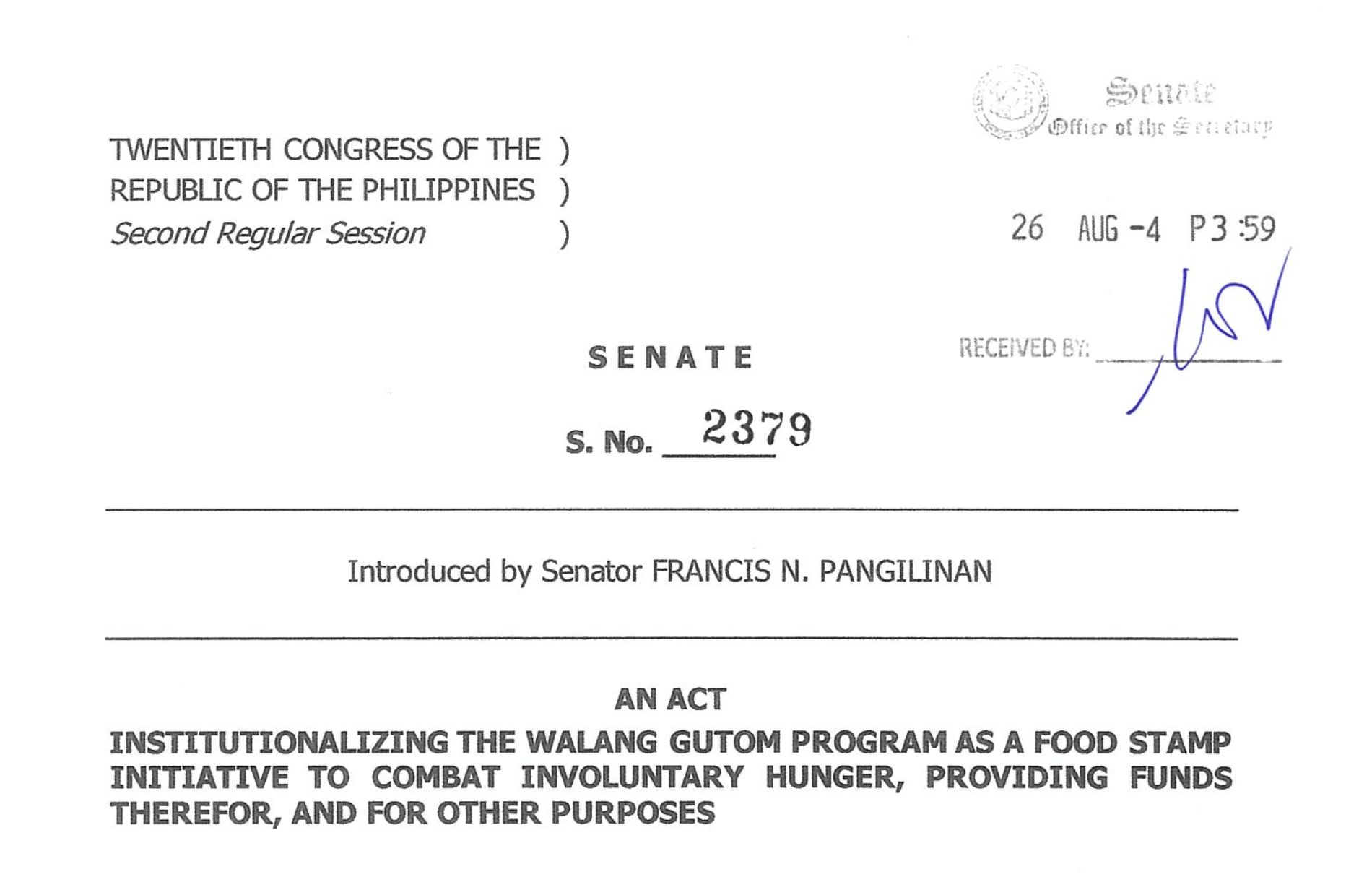
Senator Francis “Kiko” Pangilinan filed a bill seeking to institutionalize the government’s Walang Gutom Program as a “more coherent and durable national response” to pervasive hunger, food insecurity, and malnutrition.
Senate Bill No. 2379, which shall be known as the “Walang Gutom Act of 2026,” was filed last August 4 to establish a “more durable legal basis” for the government’s Walang Gutom Program, which relies primarily on executive and administrative issuances rather than actual legislation.
The lawmaker, a long-time champion of food security, said that the proposed measure recognizes that hunger is not simply a household problem but a national issue that requires a whole-of-government response.
“Kahit anong progreso at tagumpay ang matamasa natin in terms of economic figures, wala itong kwenta kapag gutom ang ating mga kababayan, lalo na ang mga kabataan sa eskwelahan. Hindi pwedeng umasenso ang isang bansa nang may naiiwang mga kababayang kumakalam ang sikmura,” he stated.
The senator said institutionalizing the program would help ensure that assistance to food-insecure families does not depend solely on short-term or temporary interventions.
“Hindi dapat paiba-iba ang tulong depende sa programa o sa kung sino ang nakaupo. Kailangan natin ng isang matatag at tuloy-tuloy na sistema para matiyak na may pagkain ang bawat pamilyang nangangailangan,” he said.
Under Pangilinan’s proposed measure, the Walang Gutom program would provide targeted food assistance to vulnerable and food-insecure households while strengthening linkages with local agricultural and fisheries producers.
He said the program can serve a dual purpose: putting food on the tables of Filipino families who need it most while ensuring that government support also reaches the farmers and fisherfolk who produce the country’s food.
In particular, the measure states that the Walang Gutom Program must be linked to relevant programs of the Department of Agriculture (DA), such as the Kadiwa outlets and food-for-school programs.
It provides for agriculture and supply chain linkages that will source food directly from local farmers and fisherfolk.
Pangilinan himself has authored and helped pass the 2019 Sagip Saka Act, which allows national government agencies and local government units to buy food directly from accredited farmers and fisherfolk cooperatives without public bidding.
If it becomes law, funding for the program shall be charged against the current appropriations for the DA, the Department of Education (DepEd), and the Department of the Interior and Local Government (DILG). Future appropriations for its continued implementation will be included in the General Appropriations Act (GAA), or the national budget.
“Walang dapat maiwan sa pag-unlad. Walang dapat nagtitiis ng gutom. Our success as a country should be measured by how we can uplift ordinary Filipinos—by making sure that they have food on the table, they have decent livelihood, and they have opportunities to succeed,” the senator said.
“Kung talagang gusto nating maging makatarungan at progresibong lipunan, dapat walang lugar ang gutom sa Pilipinas,” he added.