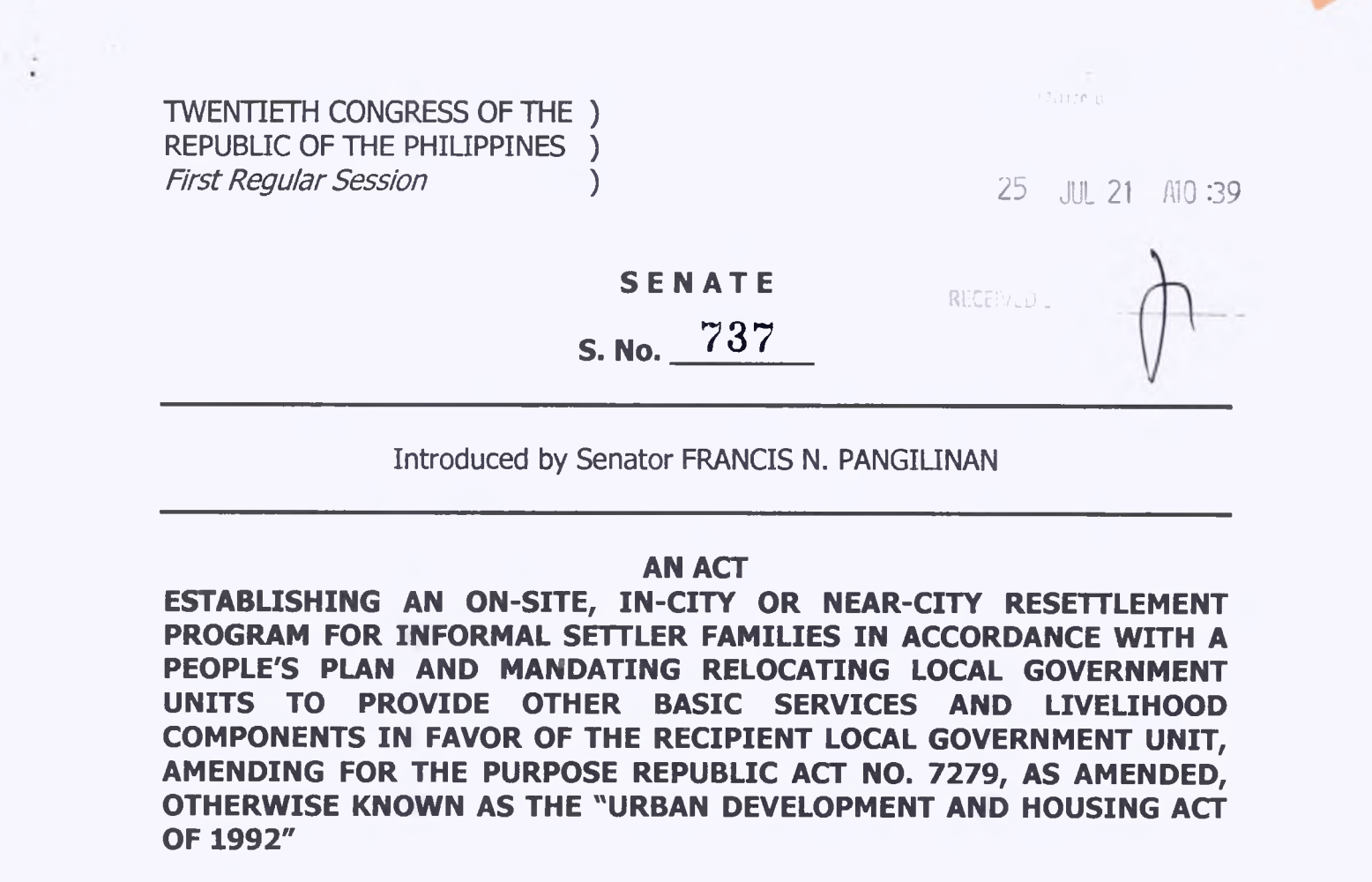
Senator Francis “Kiko” Pangilinan is pushing for the passage of a measure that would amend the Urban Development and Housing Act of 1992 (Republic Act No. 7279) to institutionalize a people-centered housing program that prioritizes safe, affordable, and humane homes within or near the communities where informal settler families live and earn their livelihood.
Pangilinan said the proposed reforms should draw from the housing approach pioneered by the late Jesse Robredo, who championed on-site and in-city relocation during his tenure as mayor of Naga City and later as Secretary of the Department of the Interior and Local Government.
“Noong secretary ng DILG si Jesse Robredo, kahanga-hanga ang ginawa niya sa urban housing shortage,” he said in his co-sponsorship speech for Senate Bill No. 2505, or “An Act Establishing an On-Site, In-City, Near-City, or Off-City Local Government Resettlement Program for Informal Settler Families in Accordance with a People’s Plan.”
The measure will amend the Urban Development and Housing Act of 1992.
“Kasama mismo ang mga informal settlers, at ilang partner-NGOs, nagkaroon ng onsite, in-city housing project. Sa proyektong ito, hindi na inilipat sa malayo ang mga naninirahan sa mga delikadong lugar tulad ng tabi ng riles ng tren, tabing-ilog, at tambakan ng basura,” the senator explained.
Pangilinan recalled that Robredo signed a department order approving a five-year P50-billion funding for the project.
“Dahil dito, libo-libong informal settler ang nakatira na sa disenteng mga bahay ngayon,” he pointed out.
The bill seeks to institutionalize “the revolutionary concept of people participation” that the late former interior chief used in his housing project.
A new section—Section 23-A—will mandate the creation of a People’s Plan within six months to one year from the receipt of a notice for a proposed resettlement or relocation.
The implementing local government unit or project proponent agency, civil society organizations, the Department of Human Settlements and Urban Development (DHSUD), the National Anti-Poverty Commission, the Presidential Commission for the Urban Poor, the local social welfare and development office concerned, and other government agencies will draft the plan.
It will include, among others, the following: a site development plan that incorporates community health, sanitation, and security; non-physical development interventions (housing cooperatives, livelihood interventions); a system of allocation of socialized housing units; and a relocation and resettlement action plan (RRAP).
The RRAP must be drafted in consultation with the affected informal settlers to ensure that their housing needs, livelihood sources, and other relevant circumstances are protected.
The measure aims to address informal settlers’ concerns about their livelihoods after relocation, with the bill prioritizing in-city resettlement before considering near-city resettlement.
“Off-city resettlement shall only be resorted to when near-city resettlement is not feasible, as determined in accordance with the RRAP, and shall be subject to adequate and responsive consultation prior to relocation,” the bill said.
Expressing support for the measure, Pangilinan emphasized that it also seeks to address the growing impact of climate change on informal settler families, highlighting the need to provide them with safe, secure, and climate-resilient resettlement sites.
“Ito ang solusyon. At may proof of concept na, kailangan na lang i-scale up,” he stated. “Safe, affordable housing near jobs, schools, health services, and social networks is essential. And that is the promise of this bill.”